Stop Guessing at Your Tax Bill and Start Knowing
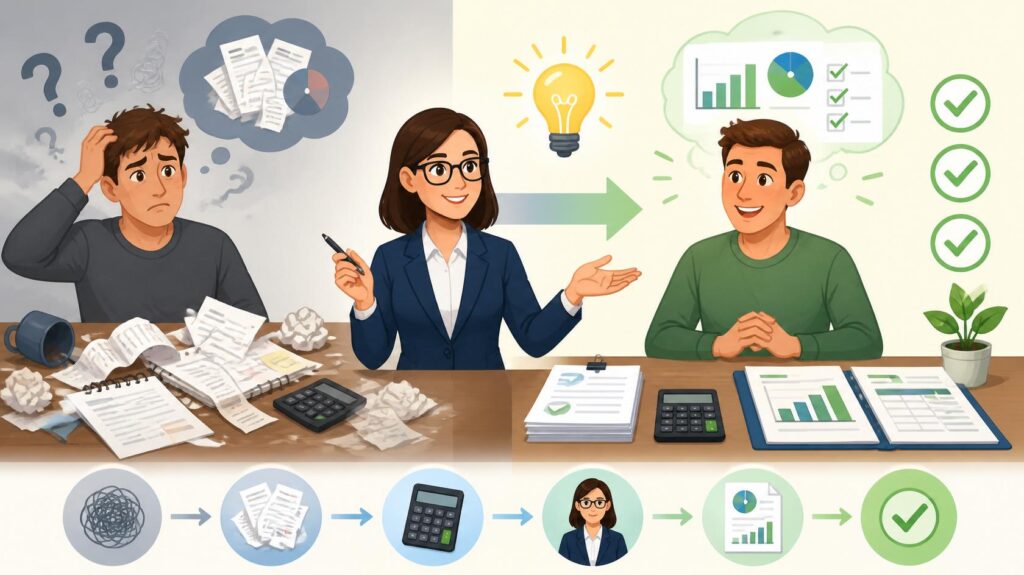
A good sole trader accountant handles your Self Assessment, makes sure you’re claiming every allowable expense, keeps you compliant with Making Tax Digital as it rolls out, and tells you clearly — with numbers, not vague advice — when it’s time to consider switching to a limited company.
Being a sole trader is refreshingly simple, right up until it isn’t. No corporation tax, no separate company accounts, just you, your income, and a Self Assessment form once a year. Then Making Tax Digital changes the reporting rules. Or your income creeps up and someone mentions you ‘should probably think about going limited.’ Or you realise you’ve been guessing at what counts as an allowable expense for two years running.
This is exactly where most sole traders either overpay HMRC out of caution, or underclaim out of not knowing the rules — both of which cost money in different ways.
The Real Value of a Sole Trader Accountant
Expenses you’re probably missing
Home office costs, a portion of your phone and internet bill, mileage, professional subscriptions, training directly related to your trade — sole traders consistently underclaim because the rules feel vague. We make them concrete.
Making Tax Digital for Income Tax
MTD for Income Tax is being phased in for sole traders above certain income thresholds, requiring digital record-keeping and quarterly updates instead of one annual return. Getting set up properly now avoids a scramble later — and avoidable penalties.
The limited company question
There’s a genuine tax-efficiency point where incorporating starts to make sense — but it’s not a fixed number that applies to everyone, and going limited too early adds admin cost without benefit. We calculate your specific breakeven point rather than repeating generic internet advice.
Payments on account confusion
Many sole traders are blindsided by payments on account — advance payments toward next year’s tax bill — because nobody explained they existed. We flag this before it becomes a surprise.
How Spartan Supports Sole Traders
- Self Assessment prepared and filed accurately, with a full expense review so nothing’s left unclaimed
- Making Tax Digital setup and quarterly digital record-keeping support
- A clear, numbers-based answer on whether and when to incorporate
- Payments on account explained in advance — no surprises in January
- Straightforward pricing with no jargon and no upsell pressure
Frequently Asked Questions
What expenses can a sole trader actually claim?
Common allowable expenses include home office costs, business travel and mileage, a proportion of phone and utility bills used for work, equipment, and professional fees. The specifics depend on your trade, which is why a proper review beats a generic checklist.
When should a sole trader switch to a limited company?
There’s usually a profit level where the tax efficiency of a limited company starts to outweigh the extra admin — but it varies by individual circumstances. We calculate this for you rather than quoting a rule of thumb.
Do I need to worry about Making Tax Digital yet?
MTD for Income Tax is being rolled out based on income thresholds, so timing depends on your earnings. We can tell you exactly where you stand and get you set up ahead of the deadline.
Need Tailored Advice?
Email: info@spartanaccounting.co.uk
Call: 0203 727 3277
Book a Non-Obligatory Discovery Call: Go here