AI Accounting Firms vs an Advisory-Led Practice: What’s Actually the Difference?
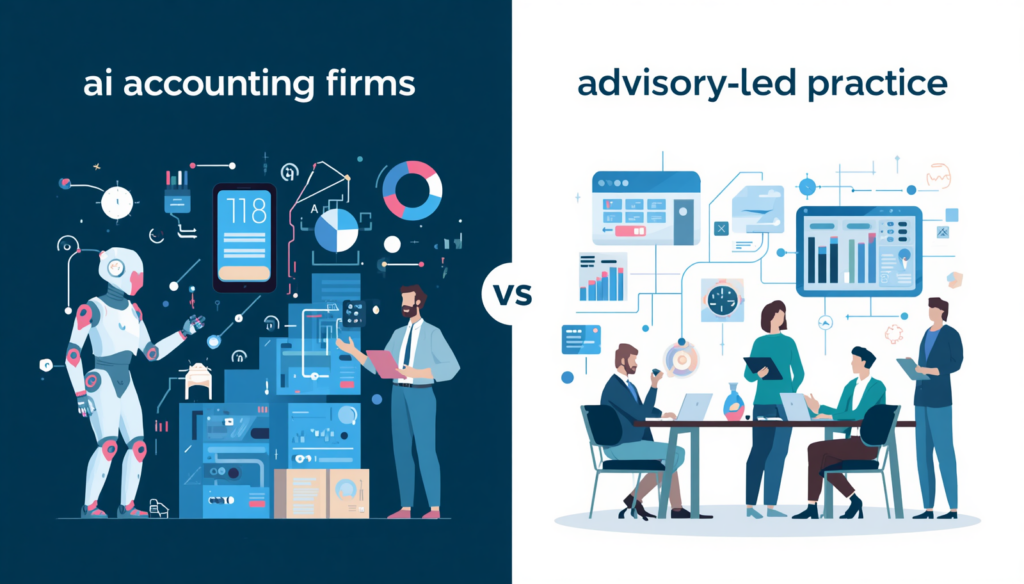
A new wave of “AI accounting firms” has arrived, promising real-time books, instant answers over WhatsApp, and a clever chatbot that reconciles your accounts while you sleep. The marketing is slick and the demos look impressive. If you run a growing business, you’ve probably been pitched one already — or you will be soon.
―
So it’s a fair question to ask: is that the future, and is a traditional accountant now just an expensive way of doing something a piece of software could do for free?
Here’s our honest answer. The automation is genuinely good, and we use plenty of it
ourselves. But there’s a hard line between the work a machine can do and the work that
actually protects and grows your business — and most of these tools sit firmly on the wrong side of it. This article is here to help you tell the difference before you commit.
What the AI tools actually do well
Let’s give credit where it’s due. The current generation of AI bookkeeping tools is good at a specific, valuable set of jobs:
Pulling transactions together from your bank, card and payment platforms continuously, rather than in a month-end scramble.
Categorising and reconciling routine transactions quickly.
Answering simple questions — “what did we spend on software last quarter?” – without you digging through a spreadsheet.
Chasing the obvious, like unpaid invoices and missing receipts.
If your business is straightforward and your only pain is that your books are slow and messy, these tools genuinely help. We’re not here to pretend otherwise. In fact, the boring, repetitive parts of bookkeeping should be automated — and at our practice, they increasingly are.
The problem isn’t what these tools do. It’s what they quietly leave out, and what happens when your situation stops being simple.
Where automation stops and judgment begins
Bookkeeping isn’t only a set of rules. A surprising amount of it is judgment—and judgment is exactly where automated tools get vague, get it wrong, or simply hand the decision back to you.
Consider a few everyday examples:
Is that £8,000 payment a repair (deductible now) or a capital improvement (relieved differently over time)? Get it wrong and you’ve misstated your profit and your tax.
Should that vehicle, that director’s loan, or that mix of salary and dividends be
structured one way or another? The “correct” categorisation depends on your wider position, not just the transaction in front of it.
You’re about to take on a property, sell a business asset, bring in an investor, or expand abroad. The right move depends on timing, on reliefs you may not know exist, and on consequences that won’t show up for months or years.
An AI agent can tell you what you’ve already done. It cannot reliably tell you what you should do next, because that requires understanding your goals, your risk appetite, your family circumstances, and the specific corners of UK tax law that apply to you. When these tools meet a genuinely ambiguous situation, they do one of two things: guess, or escalate to a human. The good ones are honest about needing a human in the loop. The question you should ask is: whose human, how experienced, and how well do they actually know your
business?
What you’re really paying an accountant for
When clients tell us we’ve earned our fee many times over, it’s almost never for the bookkeeping. It’s for the things that don’t fit in a chat window:
Spotting the problem before it becomes one the VAT registration threshold you’re about to cross, the filing deadline that carries a penalty, the structure that’s about to
cost you.
―
Tax planning, not just tax reporting — legitimately reducing what you owe by making the right decisions in advance, rather than discovering the bill after the fact.
Specialist advice when it counts — property and SDLT, capital gains timing, cross- border issues, complex VAT, succession and incorporation. This is bespoke, high- stakes work where a wrong answer is expensive.
Taking responsibility — a named, qualified person who stands behind the numbers, signs the return, and is accountable when HMRC asks questions.
That last point matters more than it sounds. An app doesn’t take responsibility. When something goes wrong, “the AI categorised it that way” is not a defence HMRC will accept.
You will be.
Our approach: automation where it helps, expertise where it counts
We don’t think this is a choice between “old-fashioned accountant” and “shiny AI tool.” That’s a false choice, and frankly the firms selling pure automation are betting you won’t notice what’s missing.
Our view is simpler. Automate the routine, and put real expertise on everything that matters. We use modern tools to keep your books accurate and up to date without the manual grind – so that the time you pay for goes into advice, planning and judgment, not data entry. You get the speed and the clean numbers, and a qualified person who knows your business and is on the hook for getting it right.
That combination is the point. Real-time books are table stakes now. What separates a genuine financial partner from a clever chatbot is what happens after the books are clean- when there’s a decision to make, a risk to manage, or an opportunity to seize.
How to choose: questions worth asking
Whoever you’re considering – a traditional firm, an “AI accounting firm,” or accounting software with an AI agent bolted on – these questions cut through the marketing:
–
1. When my situation gets complicated, who actually advises me
their qualifications?
and what are
2. Will you proactively tell me how to reduce my tax and avoid problems, or only
report what already happened?
―
3. Who is accountable to HMRC for the numbers and the filings – a named person, or
a piece of software?
4. Can you handle the specialist matters – property, capital gains, VAT, cross-border,
incorporation – or will I be sent elsewhere?
5. Do you understand my business and my goals, or just my transactions?
If the honest answer to most of those is “the app handles it,” you’re buying bookkeeping. That might be all you need today. But if you’re growing, taking decisions with real money attached, or you simply want someone in your corner who sees the whole picture, you need more than that.
The bottom line
AI has made the routine parts of accounting faster and cheaper, and that’s a good thing. We’ve embraced it. But it hasn’t replaced the reason businesses hire an accountant in the first place: judgment, foresight, specialist expertise, and a person who takes responsibility for getting it right.
The best setup isn’t a chatbot or an accountant. It’s the automation working quietly in the background, with real expertise where the stakes are high. That’s exactly how we work.
―
If you’d like to talk through what your business actually needs — and what you can safely automate – get in touch. We’ll give you a straight answer, even if that answer is “you don’t need us yet.”
Email: info@spartanaccounting.co.uk
Call: 0203 727 3277
Book a Non-Obligatory Discovery Call: Go here